
IT’S JUST NOT FAIR…
The leadership trap we can all fall into under pressure
Some SUPER-intense life experiences have been flung my way, my clients’ way and my family’s way of late. Those of you who know, know.
And I haven’t always responded exactly as I would have liked.
I’ve got cross. Frustrated. Overwhelmed. I’ve occasionally disappeared down the “IT’S JUST NOT FAIR” rabbit hole.
Sorry James and Ophelia.
I like to think, though, that I’ve course-corrected where I could.
And it has got me thinking about something I see repeatedly in my work as a leadership psychologist: what happens to our leadership when life feels unfair?
Because it is one thing for me to have a minor strop at home. It is another thing entirely to carry that energy into work and hand it, inadvertently, to everybody else.
And leaders do hand their emotional states around.
Whether you are a CEO, CFO, team leader, founder—or simply somebody trying to get something done through and with other human beings—your mindset, behaviour and emotional regulation ripple outwards.
Sometimes things really ARE unfair
An important caveat.
This isn’t about pretending everything is fine, finding a silver lining in tragedy, or denying genuine injustice, loss or difficulty.
Sometimes what happens to us is deeply, spectacularly unfair.
Positive Leadership is not blind optimism.
The question is: what do I do next?
That thought has been reinforced by my rather OBSESSIVE reading of Patrick Radden Keefe’s extraordinary London Falling.
The book investigates the death of teenager Zac Brettler and his parents’ subsequent search for truth. What particularly humbled me was the determination of Zac’s parents to keep living fully despite unimaginable grief.
Towards the end of the book comes a biblical idea from Deuteronomy that stayed with me:
Choose life.
Not: deny pain.
Not: don’t be furious.
Not: pretend this didn’t happen.
But, somehow, amid what we cannot control, keep choosing how we will respond.
That feels incredibly relevant to leadership.
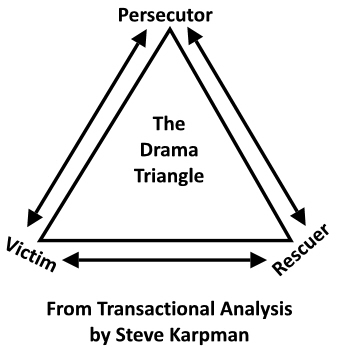
The Drama Triangle
Transactional Analysis, originally developed by psychiatrist Eric Berne, offers a useful way of understanding some of the unconscious patterns we humans fall into.
One of the best-known later models is Stephen Karpman’s Drama Triangle. It describes three positions:
Victim: “I’m powerless. There’s nothing I can do.”
Rescuer: “I’ll sort this out for everybody.”
Persecutor: “Whose fault is this?”
And here is the clever—and uncomfortable—bit. We can move between all three remarkably quickly.
Imagine a leader whose team isn’t taking enough ownership.
They start in Victim: “Why am I the only person who cares about this?”
Then move into Rescuer: “Fine. I’ll just do it myself.”
Three exhausting weeks later, Persecutor arrives: “WHY CAN’T ANYBODY AROUND HERE STEP UP?”
Recognise it?
I do.
The problem isn’t simply that these positions make us unpleasant to be around. They reduce our effectiveness.
We become more reactive. We solve the wrong problems. We disempower people. We burn energy blaming, fixing and firefighting rather than thinking.
So how do we climb out?
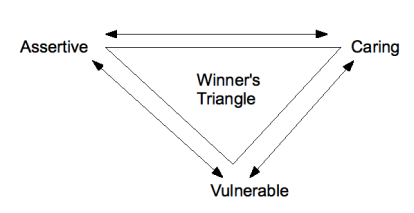
Acey Choy later developed the Winner’s Triangle, offering more constructive alternatives.
Instead of Victim, become Vulnerable—with agency: “This is really difficult. I don’t have control over everything. What DO I have control or influence over?”
Instead of Rescuer, become Caring without taking over. In leadership, I think of this as coaching: “I care about this, and I believe you are capable. What support do you need to take responsibility?”
Instead of Persecutor, become Assertive: “This isn’t working. Here is the impact. Here is what I need. How do we move forward?”
That shift sounds simple.
Under pressure, it absolutely isn’t.
But this is where leadership happens.
In ALIGHT terms, it is Abundance—moving towards possibilities, strengths and solutions—and Limberness—remaining emotionally agile enough to adapt rather than becoming trapped by our first reaction.
It is the ability to say:
This is hard AND I have choices.
I can care AND not rescue.
I can challenge AND remain respectful.
I can acknowledge what has happened AND decide what happens next.
That little word AND does a lot of heavy lifting.
A question for leaders
So, next time something goes spectacularly wrong—or someone does something that makes you want to shout “IT’S JUST NOT FAIR!”, notice what happens next.
Where do you naturally go? Victim? Rescuer? Persecutor? And then ask yourself:
What would the most empowered version of me do from here? We don’t get to choose everything that happens to us. Leadership is choosing what we do with what happens next. And perhaps, in the broadest possible sense, it is choosing life.
If this blog resonated, and you’re finding things tough right now, I'd love to talk through what's showing up for you or your leadership team.