

Picture these real high pressure scenarios that my real clients have faced. Warning, the last one is shocking.
A project you care about has slipped its timelines and the deficit is now running into the £ms. A senior stakeholder wants answers by the end of the day. Someone on your team has made a mistake, although, let’s be honest, they were working with an unrealistic deadline in the first place.
Or a major client is wavering, and your next move will decide whether they stay or walk away.
Or the phone rings and you learn that people you love from your organisation have been killed. You need to lead your organisation into recovery when you are in the midst of shock. You are sitting in your car at a junction. Turn right, and you go home to safety. Turn left, and you go to your organisation to lead a collective way forward.
These are not made up scenarios.
So what happens inside you in that split second before you act or speak?
Perhaps you feel your shoulders and jaw tighten. You start mentally drafting the email that will put things right. You want to get to the bottom of the error, fast.
Or perhaps you start to panic or overthink your next step. You want to run screaming and crying in the opposite direction.
Recognise any of that? I certainly do.
None of this makes you a poor leader. It makes you a human being with a nervous system and a huge responsibility to carry.
But these are also the moments that matter. The first question you ask or step you take may set the tone for every conversation and action that follows.
Why pressure shrinks our view
Under pressure, our attention can narrow around what is wrong, who is responsible and how to regain control. That is completely natural, and there may well be a real problem to solve. Yet if we stay there, we miss so much useful information: what has worked, what the team has learned, and which people or strengths could help us recover.
I see this in leaders in every sector I work with. The context differs, but the internal experience often sounds familiar: “I know how I want to lead, so why on earth did I react like that?”
I wish I could hand you a clever mantra that fixes it. I can’t! What I can offer is a way to buy yourself a little more choice in the moment.
Start by naming the moment
So here’s what I do, and what I invite my clients to try. When you feel that familiar surge of urgency, pause and ask yourself three questions. No one else needs to hear them.
What has actually happened? Separate the facts from the story you are already telling yourself.
What am I feeling and assuming? You do not have to share it all. You do need to know what may be shaping your response.
What does this situation need from me? It may need a decision, a question, a boundary, an apology or a conversation you have been avoiding.
This is a form of what I call Limberness: the capacity to adapt your thinking and response without losing your centre. And like any muscle, It is far easier to build when things are mildly uncomfortable than to expect it to appear for the first time in a crisis.
Back to that project meeting. Imagine you walk into it with a slightly different opening: “Let’s understand what happened, what is working that we can build on, and what needs to change.”
You have not excused the mistake. You have widened the field of attention. That is Abundance in action: seeing strengths and possibilities alongside the problem.
It sounds small, I know. But I’ve watched it shift the whole energy of a room full of anxious people. One opening invites defence. The other invites people to help find the solution.
What does the situation need next?
Of course, a good question is only the beginning. You may still need to give direct feedback. You may need to tell a client something they will not welcome. You may need to challenge the conditions that made the deadline unrealistic in the first place.
Positive Leadership asks us to hold these things together. Can we listen carefully and be honest? Can we acknowledge the pressure and ask people to meet a clear standard? Can we recognise a colleague’s strengths and address the behaviour that needs to change?
This is where our ALIGHT model comes in. I find myself coming back to these six resources again and again, with clients and in my own life. They help us think through those choices:
Abundance: What strengths or options are we overlooking?
Limberness: What response is useful now, rather than automatic?
Inspiration: What credible route forward can people see?
Grand Design: What matters enough to guide this decision?
Health: Is the way we are working sustainable?
Tribe: What conversation or relationship needs attention?
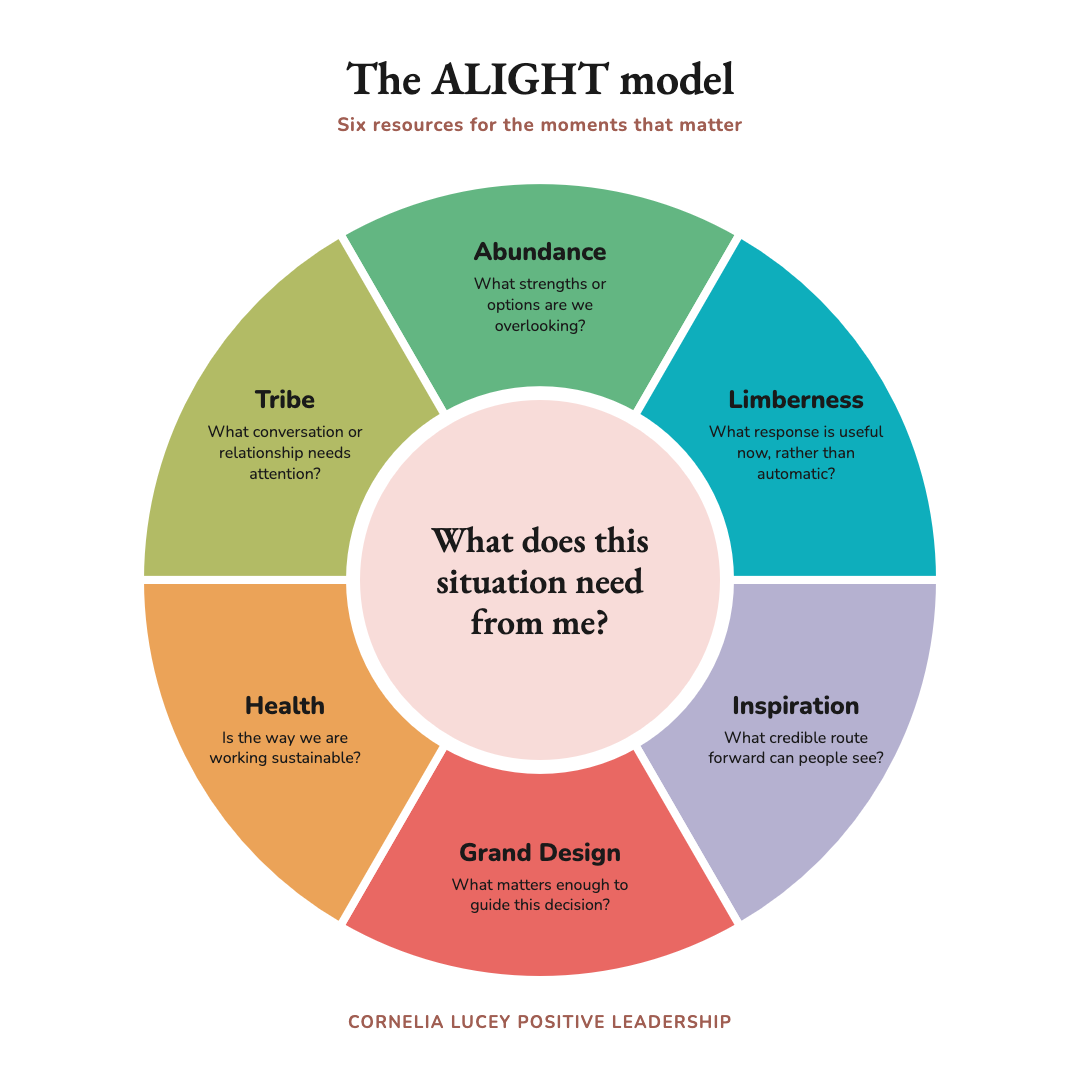
Please don’t treat these as six boxes to tick in every meeting! They work together but certain ones may need dialling up or down depending on the context. After the project setback, you might need Abundance to spot a way forward, Tribe to have a candid conversation, and Health to recognise that the team cannot keep recovering from impossible timelines through sheer effort.
Try this in one meeting this week
Choose a meeting you are secretly dreading. Beforehand, write down one sentence for each of these prompts:
My automatic response might be…
The conversation could also need…
The question I want to ask first is…
Afterwards, notice what changed. Perhaps your question helped. Perhaps you still became defensive halfway through. That’s fine. It is useful information too. Development means noticing, practising and adjusting. Nobody is asking for a perfect performance. I certainly don’t manage one.
When pressure rises, the goal is not to become a leader who never feels it. None of us gets that option. The goal is to stay aware enough to choose your next move with greater care. That is how a different leadership habit begins, one moment that matters at a time.
If this resonates, I’ll be exploring these ideas in my short ALIGHT+ taster webinar at the end of November, ‘Lead Beyond Pressure’ where we’ll use a real leadership scenario to practice identifying what a situation needs.
I’d love to see you there Join the taster
Our ALIGHT+ Positive Leadership programme begins 2 February 2027; final enrolment is 20 January 2027.